
First Steps
My first season in competitive chess.

It must have been in the summer of 1965, round about the time of my 15th birthday, that I joined Richmond & Twickenham Chess Club. I’d taken my O Levels a year early (read more about it here), and would start in the sixth form that September.
I was soon invited to play in matches, in the first instance for Richmond & Twickenham C team in Division 2 of the Thames Valley League.
For a boy who was the worst in the school at every sport and was never going to be picked for any team, getting postcards addressed to me on the doormat inviting me to play, not just for a team but for an adult team, was a great thrill, a big adventure.
This team had won the third division the previous season (just as it also did in 2025-26), but it was rather out of his depth in the second division, so my introduction to competitive chess, although I didn’t realise at the time, was pretty tough.
Our B team was in the same division, and my first match, as far as I recall, was playing for Richmond C against Richmond B. The Middlesex County Times for this period, when it reported Ealing Chess Club’s results, is available online (via the British Newspaper Archive/FindmyPast), providing details of two of my other games.
In November I was selected to play at Ealing in what might possibly have been my second match. Our second board, Keith Southan, a classics teacher at Tiffin School, would probably have given me a lift.
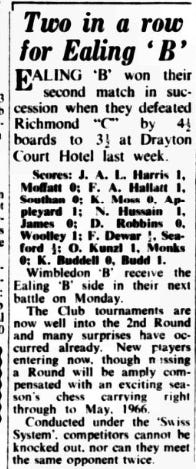
We actually came surprisingly close in this match against one of the stronger teams in the division, but, playing on the dizzy heights of Board 4, I lost my game.
A couple of months earlier, another local paper, the Acton Gazette, had published a feature on my Iraqi opponent.
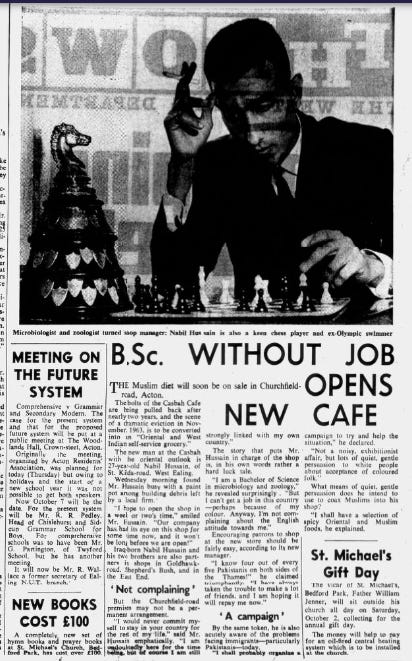
Important social history as well: despite having a BSc in microbiology and zoology he was unable to get a job because of his skin colour, but still wasn’t complaining. He was clearly very much part of the then relatively small Muslim community in London.
While there I may also have met Mike Sinclair, one of Ealing Chess Club’s leading players, a maths teacher at Hampton School and the man who ran Middlesex Junior Chess. People like him, organisers who promoted chess among secondary school age children, played a major part in setting up an environment which, after the 1972 Fischer-Spassky match, set up the English Chess Explosion.
Perhaps he gave me an entry form for the London Junior Championships, then as now taking place over the Christmas holidays.
I entered the Under 16 Reserve section, for newcomers to competitive chess, that December. I haven’t (yet) found the results, but I have a vague recollection of scoring something like 4 or 4½/7. I remember a few of the names: one of the joint winners is still active, and, as of June 2026 has an identical rating to me.

Another name I remember, Bernard Themis (we must have spoken and may have played each other) is now a prominent member of Richmond Bridge Club, meeting the other side of the bowling green from Richmond & Twickenham Chess Club.
A couple of months later Richmond C played the return match against Ealing B: I’d now been relegated to bottom board of our bottom team, where I managed to share the point.
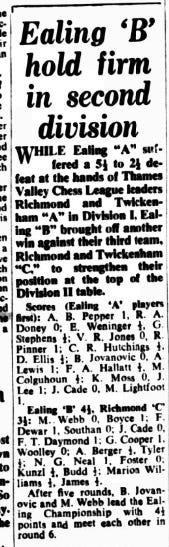
Again, I had a recollection of one of my early games being against female opposition, and this was it. I can’t find out anything very much about Marion Williams. She seems to have been the team captain, and was referred to elsewhere as Miss Marion Williams, but all the women of that name on the electoral register in the Ealing seem to have been married.
Here are the Division 1 and 2 league tables for 1965-66.
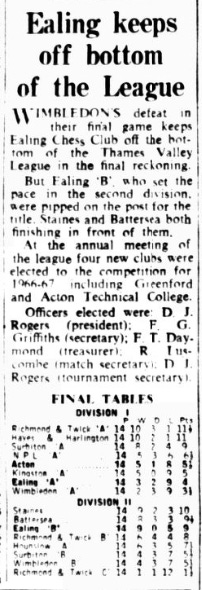
The scores of all the divisions are here. It’s interesting (and a sign of those times) to note the number of works and college teams taking part.
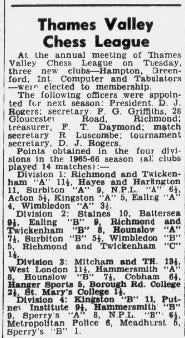
I’d have played a few more Thames Valley games that season, and perhaps one or two London League games as well. I was certainly playing in the London League at the beginning of the following season.
That September I took part in my second tournament, the senior section of the Middlesex Junior Championships, and had, by then, invested in a scorebook, which I still have. But that’s another story, perhaps for another time.
My earlier scoresheets, sadly, would have been thrown away after the games. But, from the 1966-67 season onwards, my games are all present and correct in my personal database.
But the real point is this.
I spent five years playing simple strategy games at home before learning the moves of chess at the age of 10.
This is, developmentally, exactly how it should be. As we know from Piaget, playing meaningful chess, rather than just moving the pieces round the board, is, for typically developing children, suitable for age 10 upwards. Children with an exceptional talent will benefit from starting earlier (age 7-9). Children with older family members who are knowledgeable about chess and can help them proactively will benefit from starting earlier (again age 7-9). Children where both of these are true will benefit from starting much earlier (age 5-7).
I then spent five years playing social chess before starting to play competitive chess, as you see here at the age of 15.
For me, that was the right thing again. I needed to acquire skills and knowledge before playing competitively. I’d received a subscription to British Chess Magazine the previous Christmas and religiously played through every game in every issue. I was starting to read every chess book in every library between home in Twickenham and school in Hammersmith.
This is where things are different today. A keen 11-12 year old can gain the requisite skills and knowledge much more quickly, perhaps in two years or less, by judicious use of online resources, or by reading my Chess Heroes books.
From what I recall, my first grade was 100 (about 1400 today), my second was 123 (about 1600 today) and my third 150 or maybe 151 (about 1800 today), so, once I started playing in matches and tournaments I was able to make quick progress from lower club to above average club player in a couple of years.
I’d add, though, that 1400 strength players today are much stronger than 100 strength players 60 years ago, likewise 1800 strength players are much stronger than old-time 150 strength players.
If we revert to promoting chess in secondary schools and provide links to adult clubs, you never know what might happen. Another unhappy, tongue-tied teenager might join a local club and find salvation, a place to belong, a community offering a warm welcome.
Who’d have thought that the shy 15-year-old playing bottom board for Richmond C would still be playing chess for Richmond & Twickenham Chess Club 60 years later?